Quick answer
If you suspect squirrels in your house, keep people and pets away from the affected area, leave exterior entry holes open for professional assessment, and arrange a wildlife inspection. A squirrel loose in a room needs a different response from squirrels nesting in an attic or moving through a wall. Do not start by sealing a hole, setting random traps, or opening the wall.
A squirrel crossing your roof does not by itself prove that animals are living indoors. Repeated entry through one opening, activity inside a ceiling or wall, or a squirrel in an occupied room gives you a more specific problem to investigate.
For homeowners in Marietta and Metro Atlanta, the useful first question is: Where is the squirrel, and how is it using the house? This guide explains how to respond to each situation. Dixie Exterminators provides squirrel inspection, removal, and exclusion to identify the access route and plan the next step.
How Are Squirrels Getting Into Your House?
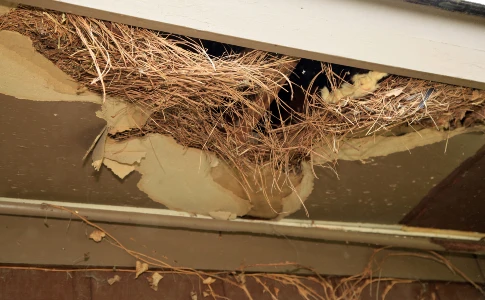
Squirrels can reach rooflines by climbing or moving from nearby trees and structures. Once there, an existing construction gap, damaged vent, or deteriorated edge can provide access. They may also enlarge an opening by chewing.
UGA Extension describes squirrel entry through roof and siding transitions and damage to soffits and other building materials. The entry is not necessarily directly above the room where you hear movement: connected roof and attic spaces can allow travel away from the original opening.
- Roof returns and fascia: Look from the ground for missing trim, exposed edges, or a hole where different roof sections meet.
- Soffits: These are the panels beneath the roof overhang. Loose or damaged sections deserve closer professional inspection.
- Attic vents: Broken louvers, displaced covers, and damaged screening can leave a usable route.
- Chimneys and roof transitions: An uncapped chimney or a gap around adjoining construction may need a different removal approach.
- Open doors or damaged screens: A squirrel in an occupied room may have entered accidentally rather than through an established attic route.
You do not need to identify every opening before calling. A ground-level photograph of a suspected entry is helpful; climbing onto the roof or reaching into an opening is not necessary.
Attic, Wall, Chimney, or Living Room: Why the Location Matters
| Where activity occurs | What to consider | Useful next step |
|---|---|---|
| Attic or ceiling | Possible access to a roof space; sound alone does not identify the animal. | Record when and where activity occurs and request an inspection. |
| Inside a wall | An animal may be traveling through a cavity or unable to get out. | Describe the exact location and any recent patching or exterior work. |
| Chimney or fireplace | Access and escape depend on the chimney construction. | Do not light a fire or open the damper to investigate; seek removal advice. |
| Bedroom, kitchen, or other occupied room | A loose animal creates an immediate contact concern. | Move people and pets away and limit access to the rest of the home if safe. |
Squirrels in the attic
Tell the technician which rooms are beneath the sound and whether you have seen animals entering outdoors. Daytime activity can fit gray squirrels, but it is not a complete identification method. Flying squirrels can be active at night, and other animals can make similar noises.
For a closer look at tracks, nesting material, chewing, and other evidence, use our existing guide to identifying squirrels in the attic. The purpose of the inspection is to combine clues rather than decide from one sound or dropping.
Squirrels inside walls
A wall noise does not automatically mean drywall must be cut. The technician first needs to understand the cavity, the animal’s location, and whether a route back to the exterior exists. A localized access opening may be considered if an animal or nest cannot be reached another way.
Avoid drilling, spraying into the cavity, or removing trim to chase the sound. Tell the company if a roof opening was recently patched, because an animal may have been left inside.
A squirrel in the chimney
A chimney can become a trap rather than a normal nesting route. Keep the fireplace unused and ask for professional guidance. Trying to smoke the animal out or opening the fireplace into the room can make the situation harder to control.
What Should You Do if a Squirrel Is Loose in a Room?
Start by reducing activity around it. Chasing, cornering, or trying to grab a squirrel increases the chance of contact and may send it deeper into the house.
- Move children and pets away. Keep pets from pursuing the animal, including pets that usually ignore squirrels outdoors.
- Limit access to other rooms if safe. Close an interior door only if you can do so without approaching or cornering the squirrel.
- Keep your distance. Do not reach behind furniture, into a cabinet, or toward a hiding animal.
- Ask about an appropriate exit or removal plan. A direct outdoor doorway may help in some situations, but the room layout, animal’s condition, and your ability to stay clear matter.
- Explain the situation when calling. Say that the animal is in an occupied room, rather than describing it only as “squirrels at the house.”
Contact a wildlife professional if you cannot isolate the area safely, the squirrel is inaccessible, or it appears injured. If a person is bitten or scratched, seek medical advice; for contact involving a pet, call a veterinarian.
Will Squirrels Leave the House on Their Own?
A squirrel may go outdoors and still continue using the house. Seeing it leave is not proof that the space is empty or that it will stay away. A shelter or nest can remain attractive while the opening is available.
This is why “I haven’t heard anything today” is not a reliable completion check. A wildlife inspection should consider recent evidence, exterior activity, accessible nesting areas, and whether young may be present.
Do not close an active hole after watching one squirrel leave. Other animals or dependent young may still be inside. Ask the technician how departure will be checked before final sealing.
When Should You Arrange Help?
Arrange an inspection when entry or indoor activity repeats, especially when you can see a damaged opening. You do not need to wait for a squirrel to enter a living area before seeking help.
Explain promptly if an animal is confined in a room, appears stuck in a wall or chimney, or if activity began after a hole was sealed. These details can change how the visit is handled.
Chewed wiring deserves assessment by a qualified electrician. Smoke, sparks, or an active fire require emergency assistance; do not enter the attic to investigate. Hearing a squirrel does not itself establish that electrical damage has occurred.
What Information Helps a Professional Find the Cause?
Before the visit, make a short record of observations you can collect safely. Specific details are more useful than trying to name the species yourself.
- The room and ceiling or wall area where movement is heard.
- The time of day and whether activity repeats in the same place.
- Photos or video taken from the ground of animals using an opening.
- Recent roofing, siding, gutter, chimney, or wildlife work.
- Any holes you or another contractor have already closed.
- Whether an attic hatch exists and whether stored items block access.
In wooded Metro Atlanta neighborhoods, tree access is one part of the inspection. The building still needs to be examined: trimming a branch will not repair a damaged soffit or confirm that squirrels have left.
The next stage is a property-specific plan. Our guide to the squirrel removal process, timeline, and cost factors explains what that plan should address.
What Should You Avoid Doing?
- Do not patch an active entry immediately. Removal and final closure need to happen in the right order.
- Do not use smoke, poison, or improvised chemical sprays. These do not provide a reliable building repair or a controlled removal plan.
- Do not disturb a nest or attempt to raise young squirrels. Ask the wildlife professional or Georgia DNR for guidance.
- Do not dry-sweep or vacuum animal waste. Leave contaminated areas undisturbed until cleanup is assessed.
- Do not assume one captured animal ends the problem. Ask how the entry route and remaining activity will be evaluated.
After the animals are out, the priorities shift to entry repairs, attic cleanup, and preventing squirrel reentry.
Frequently Asked Questions
Can squirrels get into a house without an attic?
Yes. An open exterior door, chimney, wall cavity, or accessible roof void can provide another route. The inspection should follow the actual evidence instead of assuming every squirrel problem is an attic infestation.
Does a squirrel on my roof mean it is living inside?
No. Roof activity alone does not prove entry. Repeated movement through the same opening is more informative. Record what you see from the ground and have suspicious openings assessed.
Can scratching at night still be squirrels?
It can, particularly with flying squirrels, but mice, rats, bats, and other animals can also make nighttime sounds. Timing helps an inspection; it does not confirm the species by itself.
Should I open the attic hatch to scare squirrels out?
Do not open a hatch for the purpose of chasing animals. It may create access to the living space. Tell the technician where the hatch is and let them determine how to inspect safely.
Get a Clear Answer About Squirrels Inside Your Home
Tell Dixie Exterminators where you are seeing or hearing activity and whether an animal is in an occupied room. Our wildlife team can inspect the entry points and explain the next steps for your Marietta or Metro Atlanta home.
Authoritative Resources
Sources for wildlife guidance and the precautions discussed in this guide: